Hello, LaTeX

1 Introduction

This blog is written in LaTeX, following the tradition of (Knuth 1984). Inline math like f ⁣:Rn→Rf\colon \mathbb{R}^n \to \mathbb{R} and ∥x∥2\left\lVert x \right\rVert_2 should render.

∫−∞∞e−x2 dx=π\begin{equation*} \tag{1} \int_{-\infty}^{\infty} e^{-x^2}\,dx = \sqrt{\pi} \end{equation*}

Equation (1) is classic.

2 Results

Theorem 1. For all x,y∈Rnx, y \in \mathbb{R}^n, ∣⟨x,y⟩∣≤∥x∥∥y∥|\langle x, y\rangle| \le \left\lVert x \right\rVert\left\lVert y \right\rVert.

Proof. Consider ∥x−ty∥2≥0\left\lVert x - t y \right\rVert^2 \ge 0 as a quadratic in tt. ◻

See Theorem 1 and Section 1.

a=b+cd=e\begin{align*} a &= b + c \\ d &= e \end{align*}

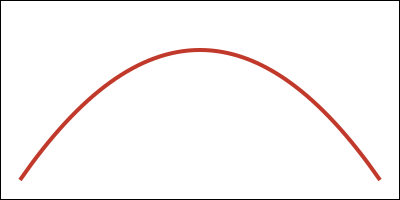
A parabola.

2.1 Code

def f(x):
    return x ** 2

References

Knuth, Donald E. 1984. The TeXbook. Addison-Wesley.